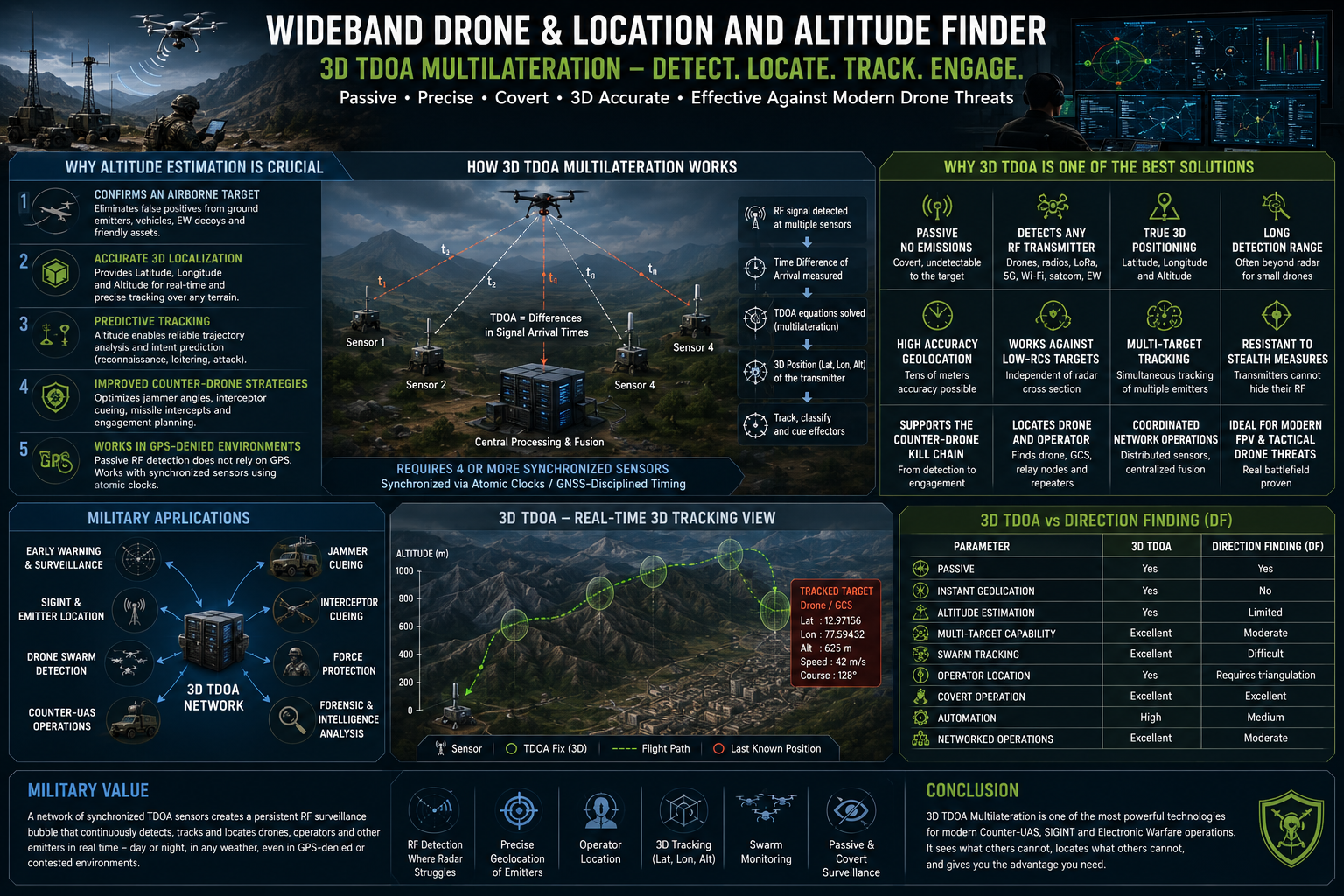
3D Time Difference of Arrival (TDOA) is highly effective because it passively detects and geolocates a transmitter by measuring the difference in signal arrival times at multiple synchronized sensors. Unlike radar, it does not require the target to reflect energy and can locate any RF-emitting source.
Key Advantages
1. Passive Detection – No Emissions
TDOA sensors do not transmit any RF energy.
Impossible for the target to detect the TDOA network through RF emissions.
Ideal for covert military and intelligence operations.
2. Detects Any RF Transmitter
FPV drones
ELRS drones
DJI drones
LoRa devices
Satellite terminals
Military radios
Cellular and Wi-Fi devices
Electronic warfare emitters
As long as the target transmits, it can potentially be detected and located.
3. True 3D Positioning
Provides Latitude, Longitude, and Altitude.
Determines the actual position of airborne drones.
Essential for cueing radars, EO/IR systems, jammers, and interceptors.
4. Long Detection Ranges
Limited primarily by RF propagation and sensor sensitivity.
Often detects transmitters beyond the range at which radar can reliably classify small drones.
Particularly effective against low-RCS drones.
5. Highly Accurate Geolocation
Multiple synchronized sensors create intersecting hyperbolic position solutions.
Accuracy can be tens of meters or better depending on:
Baseline distances
Synchronization accuracy
Signal bandwidth
Sensor geometry
6. Works Against Low-RCS Targets
Radar performance depends on Radar Cross Section (RCS).
Small FPV drones often have extremely low RCS.
TDOA is independent of RCS and depends only on RF transmission.
7. Simultaneous Multi-Target Tracking
Can track multiple transmitting drones at the same time.
Useful against drone swarms.
Supports automated threat prioritization.
8. Resistant to Stealth Measures
Paint, composites, and radar-reduction techniques do not affect TDOA.
If the drone transmits, it can be located.
9. Supports Counter-Drone Kill Chain
TDOA can provide:
Early Warning
Detection
Classification
Tracking
Geolocation
Jammer Cueing
Interceptor Cueing
Forensic Analysis
10. Excellent for Modern FPV and Tactical Drone
Threats
Lessons from Ukraine show:
FPV operators often remain several kilometers behind the frontline.
Locating the drone alone is not enough.
TDOA can locate:
The drone
The Ground Control Station (GCS)
Relay nodes
Repeaters
This enables engagement of both the drone and the operator.
Why 3D TDOA is Superior to Traditional Direction Finding (DF)
Military Value
A network of 4 or more synchronized TDOA sensors, especially when synchronized using atomic clocks or GNSS-disciplined timing, can create a persistent RF surveillance bubble that continuously detects, tracks, and locates drones, operators, and other emitters in real time.
For modern counter-drone operations, TDOA complements radar by providing:
RF detection where radar struggles,
Precise geolocation of emitters,
Operator location,
3D tracking,
Swarm monitoring,
Passive and covert surveillance.
This makes 3D TDOA one of the most powerful technologies for modern Counter-UAS, SIGINT, and electronic warfare applications.