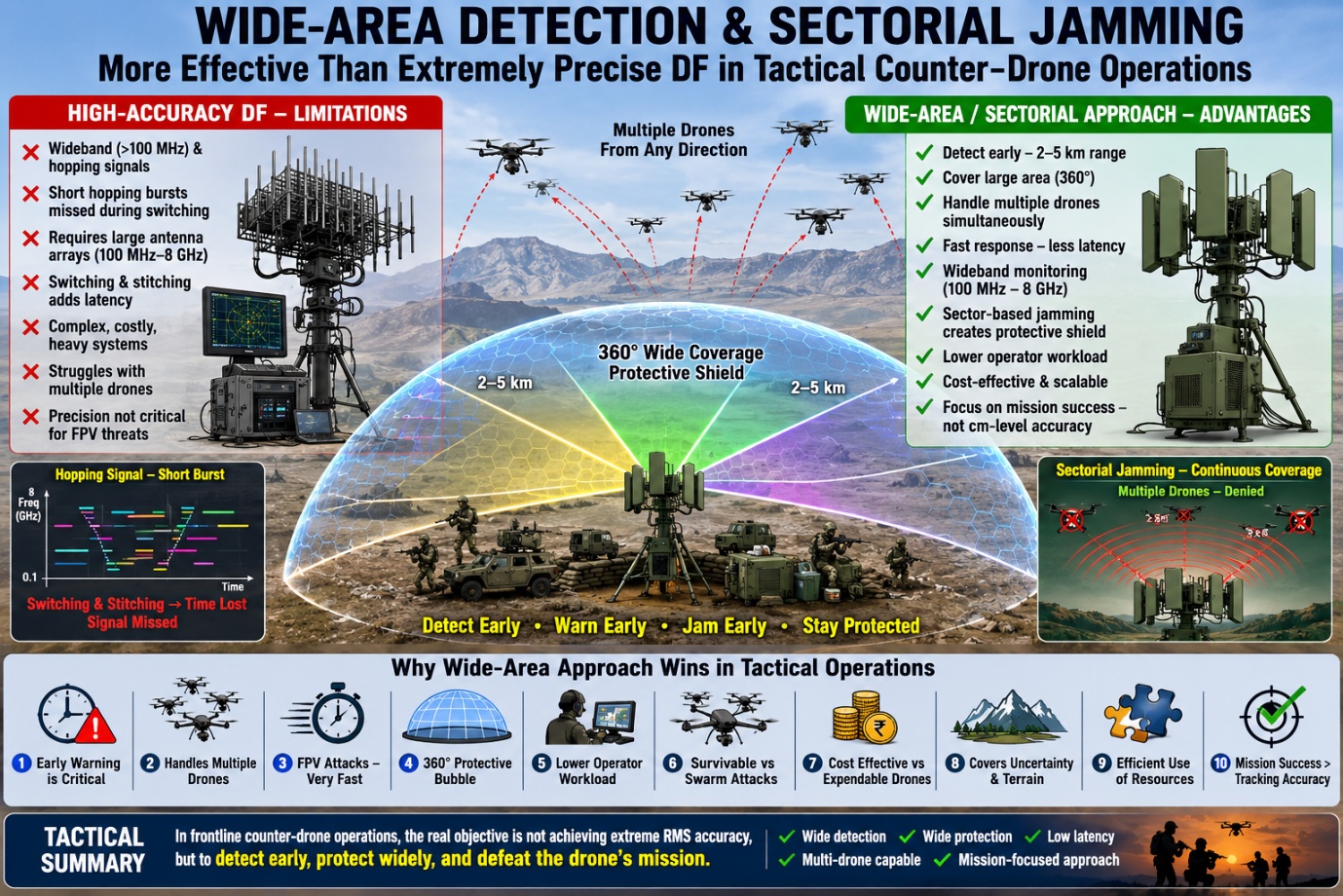
Why Wide-Area Detection and Wide-Area Jamming Can Be More Effective Than Extremely Precise RMS Accuracy in Tactical Counter-Drone Operations
- Early warning is more important than pinpoint accuracy. Detecting a drone 2–5 km away gives soldiers valuable reaction time to take cover, deploy countermeasures, or engage the threat.
- Modern battlefields involve multiple drones simultaneously. A system covering a large area can detect and counter several threats at once rather than focusing on a single precisely tracked target.
- FPV attacks happen very quickly. In many cases, knowing a drone is approaching is more important than determining its exact location within a few meters.
- Wide-area jamming creates a protective bubble. Soldiers remain protected regardless of the direction from which the drone approaches.
- Reduced operator workload. Operators do not need to continuously identify, track, and point at individual drones before taking action.
- Higher survivability against swarm attacks. Multiple drones arriving from different directions can overwhelm highly accurate but narrow-field systems.
- Works against low-cost, expendable drones. Spending significant resources to achieve very high tracking precision may not provide proportional tactical benefits against mass-produced FPV drones.
- Covers uncertainty in target location. GPS errors, terrain masking, and rapidly maneuvering drones can reduce the practical value of extremely precise coordinates.
- Resource efficiency. One wide-area detection and protection system can often protect a larger force element than multiple highly specialized precision systems.
- Battlefield success depends on threat denial, not measurement accuracy. The objective is to prevent the drone from completing its mission. If a system detects the threat early and provides sufficient protection, achieving centimeter-level tracking accuracy may offer limited additional tactical value.
Tactical Summary
In frontline counter-drone operations, creating a large detection and protection envelope is often more valuable than achieving extremely high RMS tracking accuracy. The key requirement is to provide early warning, protect personnel from threats approaching from any direction, and counter multiple drones simultaneously while minimizing operator workload and resource expenditure. The measure of success is not how precisely a drone is tracked, but whether the force remains protected and the drone's mission is defeated.