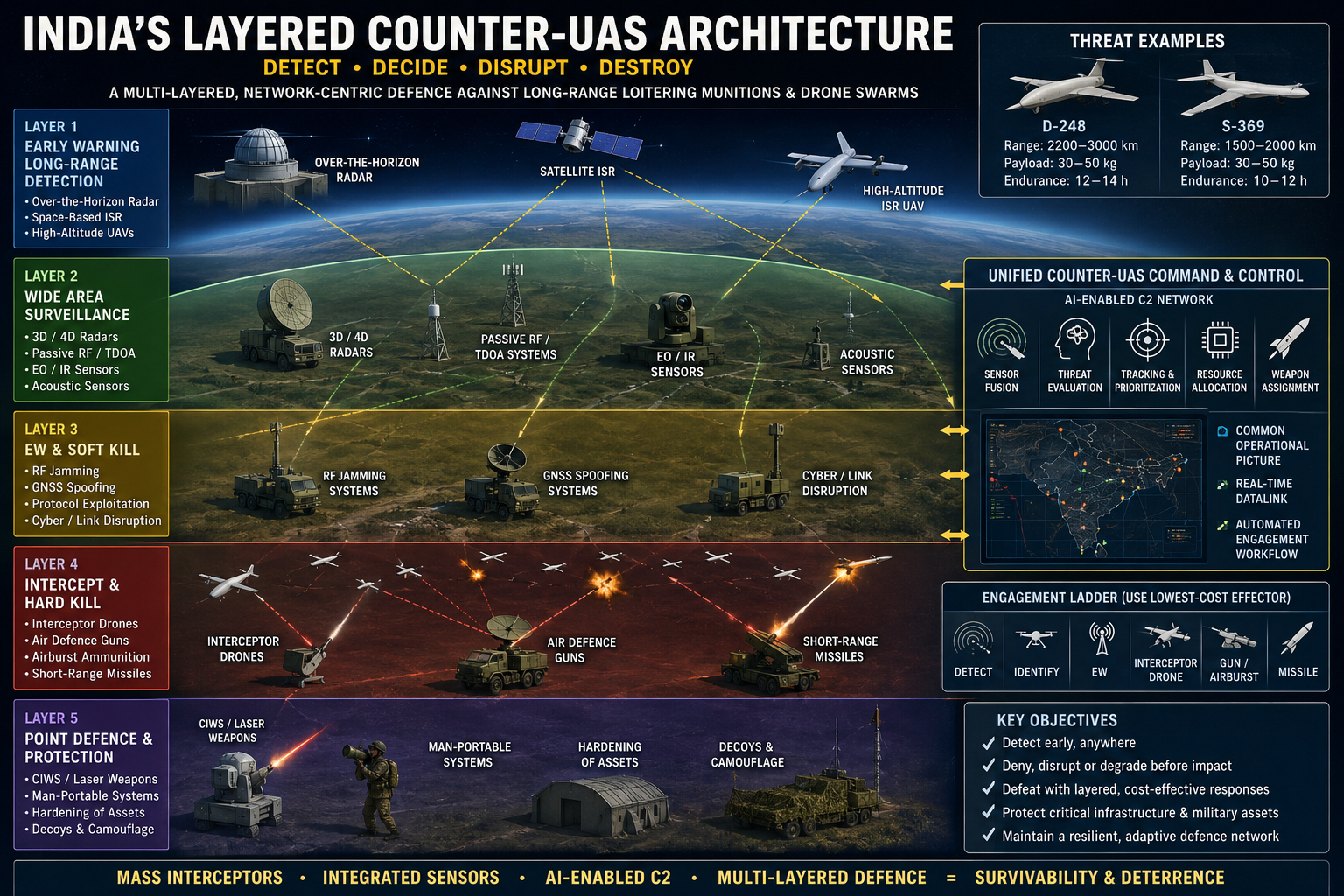
The answer is not one jammer, one radar, or one interceptor. India needs a national, layered Counter-UAS architecture designed around mass attacks by autonomous and long-range one-way attack drones. NATO’s 2026 Layered Counter-UAS Initiative is moving in exactly this direction—integrating detection, C2, EW and multiple effectors rather than treating each system independently. ()
For the threat described above, I would prioritize the solution like this:
- National Counter-UAS C2 Network — highest priority. Connect military radars, CUAS radars, passive RF/TDOA sensors, EO/IR, acoustic sensors, jammers, spoofers, guns and interceptor drones into one real-time operational picture. Every detected drone should become a common track that can be handed automatically from one sensor or effector to another. Recent U.S. and NATO programs similarly emphasize integrated mission command and interoperability rather than isolated counter-drone equipment. ()
- Mass-produce low-cost interceptor drones. This is probably the most important hard-kill investment. India needs very large interceptor inventories—not dozens, but ultimately thousands—because expensive SAMs cannot economically defeat large numbers of relatively cheap one-way attack drones. The U.S. Army is already evaluating low-cost kinetic interceptors specifically to strengthen layered C-UAS defence, while other programs are fielding reusable AI-enabled interceptor drones. ()
- Build a multi-layer sensor grid rather than depending on RF detection. Long-range surveillance radar provides initial warning; dedicated 3D/4D drone radars handle lower-altitude targets; passive RF/TDOA detects emitting drones and can help geolocate them; EO/IR provides confirmation; acoustic detection can supplement very-low-altitude coverage. This is critical because autonomous, pre-programmed and other non-emitting drones cannot be defeated simply by searching for their control link. Layered sensing is a core principle in contemporary C-UAS architectures. ()
- Treat EW as one layer—not the complete solution. Deploy wide-area RF jamming, GNSS denial/spoofing where operationally appropriate, protocol-aware countermeasures and directional/sectorial EW. But every defended location should assume that some drones will continue flying after communications and GNSS are denied. Those targets must automatically transition to interceptor, gun or other hard-kill engagement.
- Create a cheap-to-expensive engagement ladder. The C2 should select the lowest-cost effective response: electronic defeat when possible → reusable interceptor → expendable interceptor → gun/airburst solution → higher-cost missile only where necessary. Cost-per-kill matters enormously when defending against hundreds or thousands of inexpensive drones; recent U.S. Army analysis specifically highlights this economic problem and argues for layered responses. ()
- Defend in depth rather than only around the final target. Establish an outer surveillance layer for early warning, an intermediate interception layer and a terminal point-defence layer around airfields, ammunition depots, command centres, radar sites, logistics hubs and other critical infrastructure. The objective is to obtain multiple engagement opportunities rather than discovering a one-way attack drone when it is already seconds from impact.
- Harden India's own interceptor and surveillance infrastructure. Interceptors and surveillance UAVs should have resilient navigation, secure communications and alternative positioning/navigation methods so that hostile EW does not disable the defensive system itself. Counter-UAS networks also need redundant communications and distributed command so losing one node does not collapse the air-defence picture.
- Create one continuously evolving national test environment. Pakistan or China can change navigation, autonomy, communications or flight profiles much faster than a conventional procurement cycle. India therefore needs continuous operational testing, threat-library updates, EW testing and rapid software updates. NATO's current LCI-X program similarly emphasizes rapid experimentation and integration against evolving drone threats. ()
What I would build for India
The architecture should essentially be:
Long-Range Surveillance → Passive RF/TDOA + 3D/4D Radar → EO/IR Identification → AI Threat Evaluation → Unified C2 → EW / Interceptor Drone / Gun / Missile → Automatic Battle-Damage Assessment
with all of it connected into one nationwide Counter-UAS command network.
The critical shift is from buying “counter-drone systems” to building a Counter-UAS ecosystem.
For a Shahed-class threat specifically, my investment priority would be roughly:
Detection & C2 → Mass interceptor drones → guns/low-cost terminal defence → EW → high-energy/laser systems where appropriate → expensive SAMs as the final layer.
This would also address the fundamental problem raised in your original text: even if an adversary develops CRPA, autonomous navigation and highly resilient communications, the defence does not depend on breaking that communication link. Radar detects the physical aircraft, the C2 tracks it, and kinetic/interceptor layers can still engage it.
The strongest Indian response therefore isn't necessarily trying to reproduce every Pakistani communication technology. It is building an architecture capable of defeating the drone even when its GNSS cannot be jammed and its data link cannot be disrupted. That is the more durable solution.