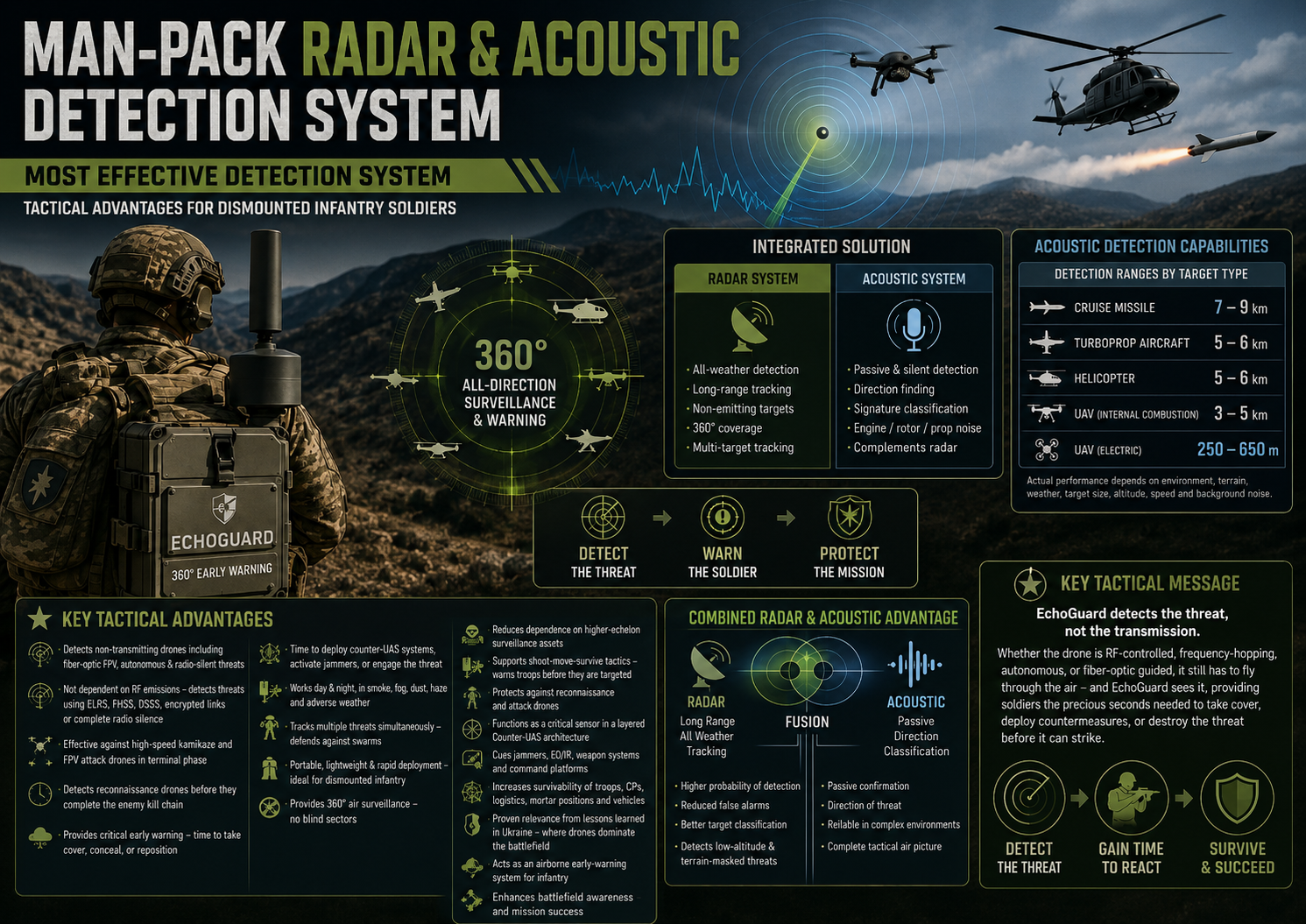
MAN-PACK RADAR & ACOUSTIC DETECTION SYSTEM
MULTI-SENSOR EARLY-WARNING SOLUTION FOR DISMOUNTED INFANTRY
Tactical Advantages for Dismounted Infantry Soldiers
EchoGuard combines compact radar and advanced acoustic detection to provide continuous, all-direction early warning against drones, helicopters, aircraft, and other airborne threats.
The radar detects and tracks physical targets in the air, while the acoustic sensor identifies and classifies threats through their unique engine, propeller, rotor, and aerodynamic sound signatures. Together, these complementary sensors provide greater detection reliability, improved classification, and increased battlefield survivability.
- Provides critical early warning against incoming drone and aerial threats, giving soldiers valuable time to react.
- Detects non-transmitting drones, including fiber-optic FPV drones, autonomous UAVs, pre-programmed platforms, and radio-silent threats.
- Detects the physical presence and acoustic signature of a target without depending on RF control-link emissions.
- Effective against high-speed kamikaze drones and FPV attack drones during their approach and terminal attack phases.
- Detects drones operating through ELRS, FHSS, DSSS, encrypted communication links, autonomous navigation, or complete radio silence.
- Provides continuous 360° surveillance and warning against threats approaching from any direction.
- Uses acoustic direction finding to estimate the direction of incoming drones, aircraft, helicopters, and cruise-missile-type threats.
- Improves target confirmation by correlating radar tracks with detected acoustic signatures.
- Helps classify targets by distinguishing between electric UAVs, combustion-engine UAVs, helicopters, turboprop aircraft, and other aerial threats.
- Detects reconnaissance drones before they can complete the enemy kill chain and direct artillery, mortar, or FPV strikes.
- Enables soldiers to immediately take cover, disperse, conceal themselves, or reposition before becoming a target.
- Provides valuable reaction time to deploy counter-UAS systems, activate jammers, cue EO/IR sensors, or kinetically engage the threat.
- Works during day and night and does not depend on ambient light conditions.
- Radar maintains surveillance in smoke, fog, dust, haze, darkness, and adverse battlefield conditions where visual observation becomes ineffective.
- Acoustic sensing provides an additional passive detection layer, particularly against low-flying and terrain-masked threats.
- Tracks and warns against multiple aerial threats, supporting defence against coordinated attacks and drone swarms.
- Provides passive acoustic surveillance without transmitting RF energy, reducing the probability of detection by hostile electronic-support systems.
- Portable and lightweight for use by dismounted infantry, special forces, reconnaissance teams, and forward-deployed units.
- Can be rapidly deployed to protect patrol bases, observation posts, checkpoints, command posts, mortar positions, logistics nodes, and temporary tactical locations.
- Reduces dependence on higher-echelon surveillance assets by giving infantry an organic air-warning capability.
- Supports shoot–move–survive tactics by warning troops before enemy drones can identify, track, or attack their position.
- Provides protection against reconnaissance, surveillance, targeting, and attack drones.
- Functions as a critical sensor layer within an integrated Counter-UAS architecture.
- Automatically cues jammers, EO/IR cameras, weapon stations, interceptor systems, and command-and-control platforms.
- Enhances the survivability of troops, command elements, logistics areas, artillery positions, vehicle staging areas, and other high-value tactical assets.
- Incorporates important battlefield lessons from Ukraine and other recent conflicts, where drones have become primary reconnaissance, targeting, and strike platforms.
- Acts as an organic airborne early-warning capability for infantry, significantly improving battlefield awareness and force protection.
Acoustic Detection Capabilities
The acoustic subsystem uses a distributed microphone array and intelligent signal-processing algorithms to detect, locate, and classify aerial threats through their distinctive sound patterns.
Indicative Detection Ranges by Target Type
- Cruise Missile: 7–9 km
- Turboprop Aircraft: 5–6 km
- Helicopter: 5–6 km
- Internal-Combustion UAV: 3–5 km
- Electric UAV: 250–650 m
Actual detection performance may vary depending on target size, altitude, speed, acoustic signature, terrain, wind, background noise, weather conditions, and sensor deployment configuration.
Combined Radar and Acoustic Advantage
Radar provides long-range, all-weather detection and accurate tracking, while the acoustic system offers passive detection, directional warning, and target classification.
By fusing radar tracks with acoustic signatures, EchoGuard can:
- Increase the probability of detection.
- Reduce false alarms.
- Improve target classification.
- Detect low-altitude and terrain-masked threats.
- Provide passive confirmation of an approaching target.
- Determine the approximate direction of the threat.
- Maintain warning capability when one sensor is affected by terrain, clutter, interference, or environmental conditions.
- Deliver a more reliable and complete tactical air picture to the soldier.
Key Tactical Message
EchoGuard detects the threat—not merely its transmission.
Whether a drone is RF-controlled, frequency-hopping, autonomous, encrypted, radio-silent, or fiber-optic guided, it must still move through the air and produce a physical or acoustic signature.