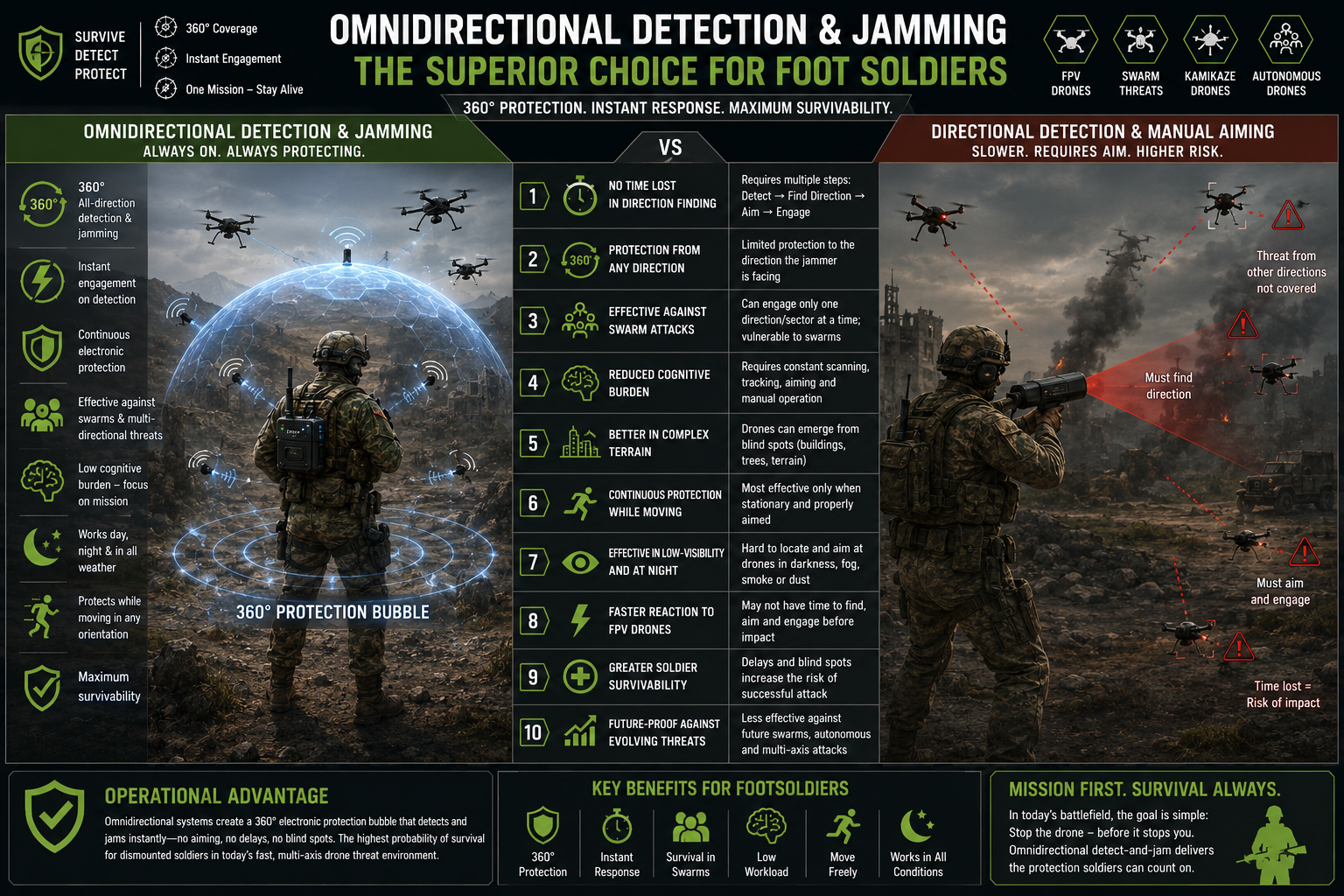
Why Omnidirectional Detection & Jamming is Superior for Foot Soldiers
1. No Time Lost in Direction Finding
Small FPV and kamikaze drones can travel at very high speeds and may appear with little warning. A directional system requires:
- Detecting the drone
- Determining its direction
- Orienting the jammer toward the threat
- Maintaining aim during engagement
These steps consume valuable seconds, which may be the difference between survival and impact.
2. Protection Against Attacks from Any Direction
Modern battlefields are highly dynamic. Drones can approach from:
- Front
- Rear
- Flanks
- High elevation angles
An omnidirectional system continuously monitors and protects the soldier in all directions without requiring manual intervention.
3. Effective Against Swarm Attacks
Multiple drones may attack simultaneously from different directions. A directional jammer can typically engage only one sector at a time, while an omnidirectional jammer creates a protective electronic bubble around the soldier, increasing survivability against coordinated attacks.
4. Reduced Cognitive Burden on Soldiers
Under combat conditions, soldiers are already focused on:
- Situational awareness
- Enemy fire
- Navigation
- Communication
Requiring them to locate and aim at drones adds significant workload. An automatic omnidirectional system allows soldiers to remain focused on their primary mission.
5. Better Performance in Urban and Complex Terrain
In urban areas, forests, mountains, and trenches, drones can suddenly emerge from blind spots. Omnidirectional coverage eliminates the need to continuously scan and track potential threat directions.
6. Continuous Protection While Moving
Directional systems are most effective when stationary and properly aimed. Foot soldiers are constantly moving, taking cover, and changing orientation. Omnidirectional systems provide uninterrupted protection regardless of body position or movement.
7. Improved Night and Low-Visibility Operations
At night, in fog, smoke, or dust, visually locating a drone can be extremely difficult. Omnidirectional RF detection and jamming remain effective even when the threat cannot be seen.
8. Faster Reaction to FPV Drones
FPV drones often attack at low altitude and high speed. There may be insufficient time to identify the threat direction and bring a handheld jammer onto target. Omnidirectional systems engage immediately upon detection.
9. Greater Soldier Survivability
The objective is not necessarily to identify where the drone is coming from, but to prevent it from successfully attacking. Omnidirectional systems prioritize immediate protection and survivability.
10. Future-Proof Against Evolving Drone Threats
Recent conflicts have demonstrated that drone attacks are becoming:
- More numerous
- Faster
- More autonomous
- More coordinated
An omnidirectional approach provides a scalable defense against future swarm and multi-axis attack tactics.
Operational Conclusion
For individual soldiers and small infantry teams, an omnidirectional detect-and-jam approach provides the highest probability of survival because it delivers continuous 360° protection, eliminates engagement delays, reduces operator workload, and remains effective against simultaneous multi-directional drone attacks.
Directional detection and handheld jamming may still have value for specialized applications requiring longer range or precise engagement, but for frontline troops facing fast-moving FPV and swarm threats, an omnidirectional electronic protection bubble offers the most practical and effective all-round defense.