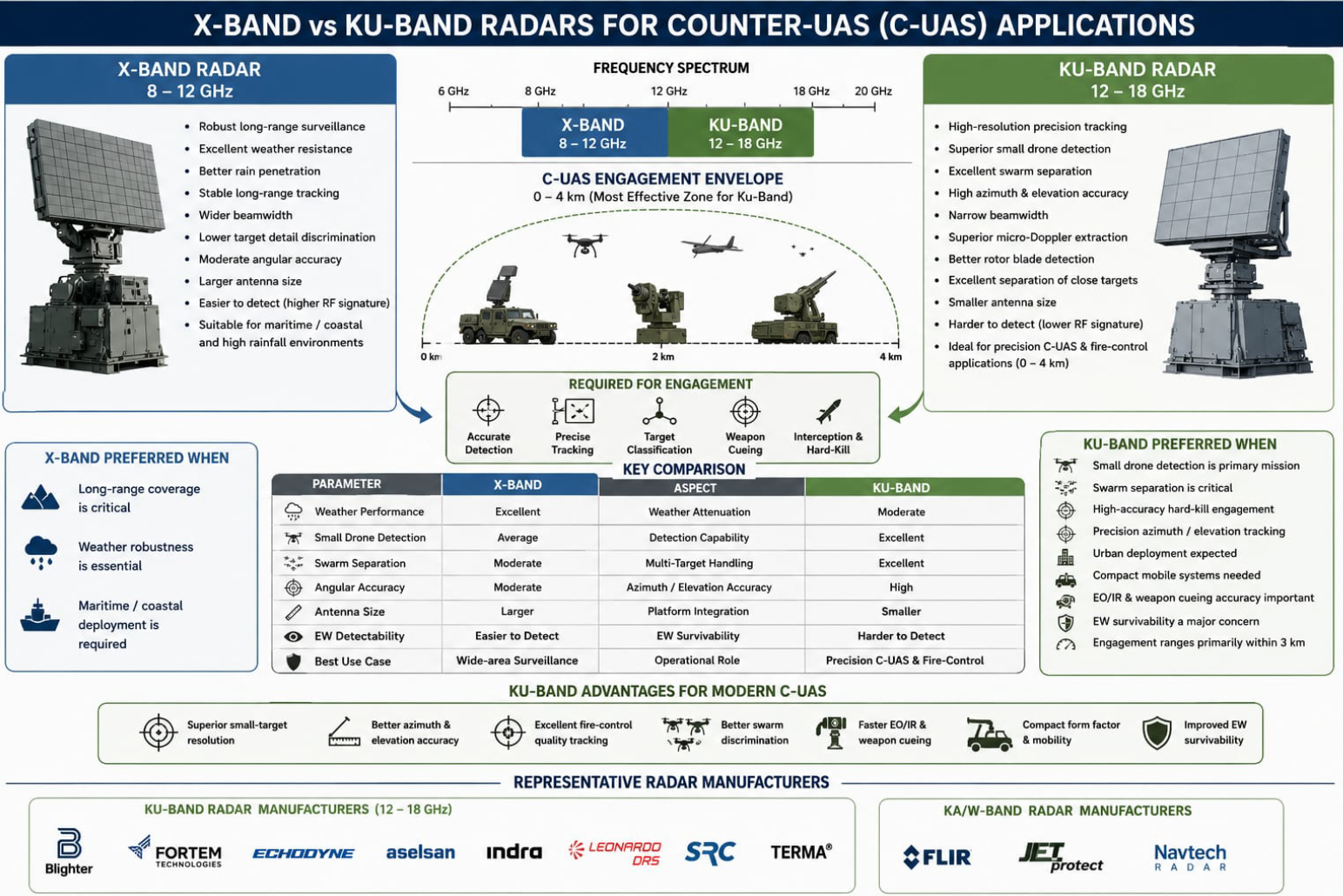
All Systems Needs Accurate Precision for engagement of Interception & Hard-Kill
X-Band is most easy to attack using radiation tracking missiles and drones we need to restrict our radiating power
Overview
The choice between X-band and Ku-band radar is one of the most important design decisions in modern Counter-UAS (C-UAS) and low-altitude air surveillance systems. Both bands are widely used for drone detection, tracking, classification, and fire-control support, but they are optimized for different operational priorities.
| Parameter | X-Band | Ku-Band |
|---|---|---|
| Frequency Range | 8–12 GHz | 12–18 GHz |
| Wavelength | Longer | Shorter |
| Detection Philosophy | Robust long-range surveillance | High-resolution precision tracking |
| Weather Resistance | Excellent | Moderate |
| Small Drone Detection | Average | Excellent |
| Swarm Separation | Moderate | Excellent |
| Angular Accuracy | Moderate | High |
| Elevation Accuracy | Average | High |
| Antenna Size | Larger | Smaller |
| EW Detectability | Easier to detect | Harder to detect |
| Best Use Case | Wide-area surveillance | Precision CUAS & fire-control |
Technical Comparison
1. Resolution, Tracking & Weapon Engagement
Ku-band radars operate at higher frequencies with shorter wavelengths, enabling:
- Better azimuth accuracy at ranges
- Better elevation accuracy at Ranges
- Narrower beamwidth
- Improved track precision
- Superior micro-Doppler extraction
- Better rotor blade detection
- Improved separation of closely spaced drones
*This provides significantly better fire-control quality tracking for:*
- Hard-kill weapon systems
- Remote weapon stations
- Airburst ammunition systems
- SHORAD/C-UAS interceptors
- Gun-based anti-drone systems
Ku-band becomes especially effective inside the 0–4 km engagement zone, where extremely accurate tracking and continuous target updates are critical for successful hard-kill engagement.
Because of the tighter beam and higher angular precision, Ku-band offers:
- Faster target handoff to EO/IR systems
- Better lead-angle computation
- Improved engagement probability
- Better multi-target tracking during swarm attacks
- Reduced engagement errors in dense drone environments
This makes Ku-band highly suitable for:
- Swarm detection and tracking
- FPV drone defense
- Low-altitude urban air defense
- Precision anti-drone weapon cueing
X-band provides good surveillance capability but generally offers lower target-detail discrimination and lower fire-control precision compared to Ku-band.
2. Swarm Detection Advantage
Drone swarm warfare requires:
- High revisit rates
- Tight beamforming
- Precise target separation
- Fast track updates
- Simultaneous multi-target handling
Ku-band performs exceptionally well in swarm scenarios because:
- Smaller beamwidth reduces track merging
- Better angular separation allows drones flying close together to be individually tracked
- Higher update rates improve engagement sequencing
- Better classification capability improves AI-driven threat prioritization
In dense swarm environments, X-band systems may experience:
- Target merging
- Reduced separation accuracy
- Lower engagement-quality tracking
Ku-band is therefore increasingly preferred for next-generation swarm-defense architectures.
3. Weather Performance
X-band is significantly more weather tolerant because of its lower atmospheric attenuation.
Only If your AOR is high rain terrain
Advantages include:
- Better rain penetration
- Reduced fog and humidity losses
- More stable long-range tracking
- Better performance in coastal and monsoon environments
4. Antenna Size & Mobility
Ku-band allows much smaller antenna apertures while maintaining narrow beamwidth.
Advantages include:
- Compact radar systems
- Easier vehicle integration
- Lower mast requirements
- Better portability
- Faster deployment
- Easier integration on mobile tactical platforms
X-band systems typically require larger arrays for similar beam performance.
5. Electronic Warfare (EW) Survivability
A major modern battlefield consideration is radar emission detectability.
X-Band
- Easier to detect by ESM/ELINT systems
- Wider beam exposure
- More mature anti-radiation seeker ecosystem
- Greater vulnerability to RF-homing drones and loitering munitions
Ku-Band
- Narrower beams
- Reduced sidelobe exposure
- Smaller RF footprint
- More difficult passive detection and triangulation
Ku-band radars are generally harder to target using passive RF seekers, increasing survivability in contested EW environments.
Operational Preference
X-Band Preferred When:
- Long-range coverage is critical with less accuracy and more clutter
- Weather robustness is essential
- Maritime/coastal deployment is required
Ku-Band Preferred When:
- Small drone detection is the primary mission
- Swarm separation is critical
- High-accuracy hard-kill engagement is required
- Precision azimuth/elevation tracking is necessary
- Urban deployment is expected
- Compact mobile systems are needed
- EO/IR and weapon cueing accuracy is important
- EW survivability is a major concern
- Engagement ranges are primarily within 3 km
Final Assessment
Ku-band is increasingly becoming the preferred choice for modern Counter-UAS missions because of its:
- Superior small-target resolution
- Better azimuth and elevation accuracy
- Improved fire-control quality tracking
- Better swarm discrimination
- Compact form factor
- Faster weapon cueing capability
- Improved EW survivability
For modern hard-kill C-UAS systems operating inside short and medium engagement ranges, Ku-band offers one of the most accurate and operationally effective radar solutions currently available.
Ku-Band suppliers
- Blighter
- Fortem
- Echodyne
- Aselsan
- Infiniti Electro-Optics
- K&G Spectrum
- Indra
- Leonardo DRS
- SRC
- Terma
Ka/W-Band suppliers
- FLIR
- JETprotect
- Navtech