Why Smart SDR-Based Jamming with Modulation Selection is More Effective Against ELRS Tactical Drones than Conventional "Look-Through" Jamming
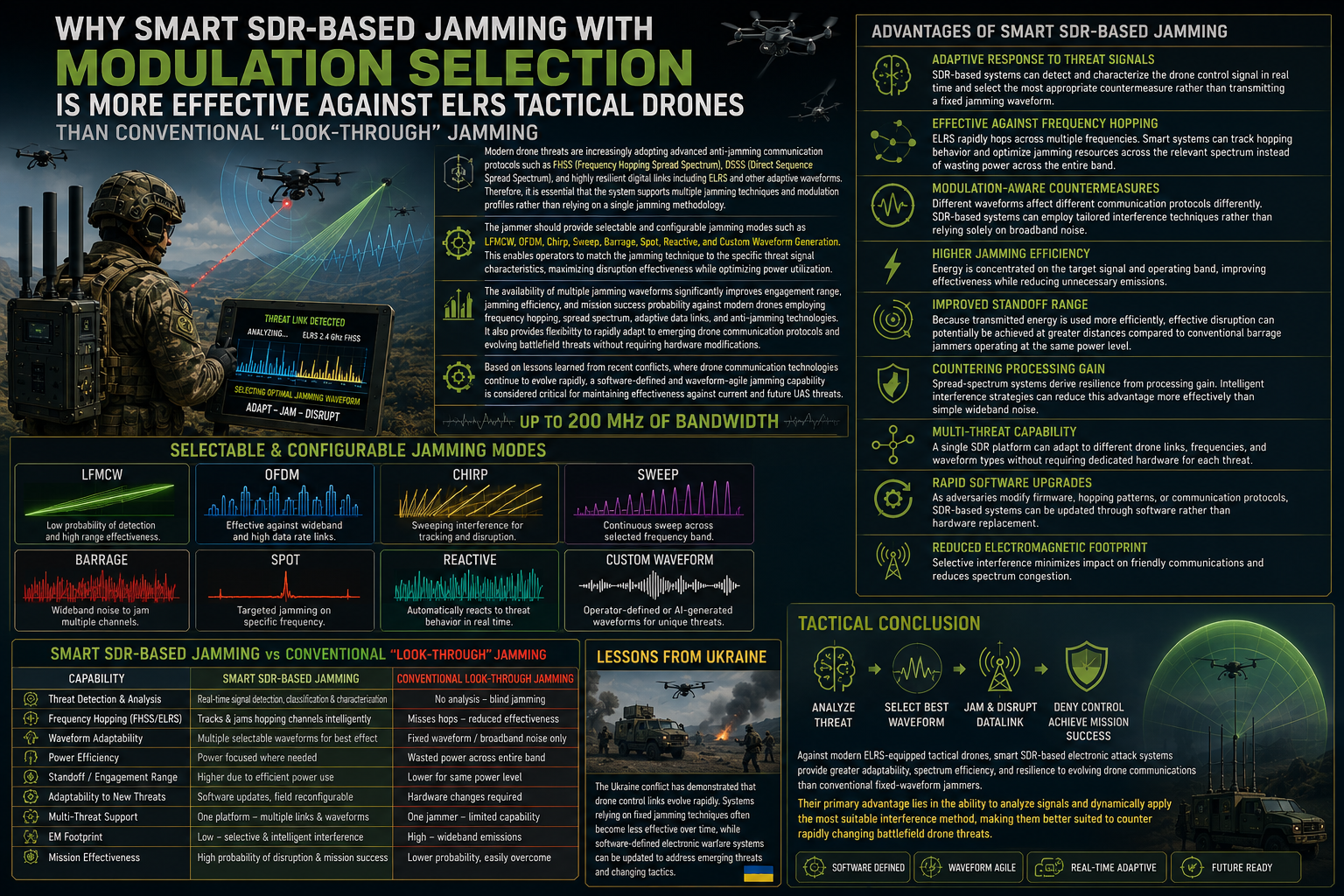
Modern drone threats are increasingly adopting advanced anti-jamming communication protocols such as FHSS (Frequency Hopping Spread Spectrum), DSSS (Direct Sequence Spread Spectrum), and highly resilient digital links including ELRS and other adaptive waveforms. Therefore, it is essential that the system supports multiple jamming techniques and modulation profiles rather than relying on a single jamming methodology.
The jammer should provide selectable and configurable jamming modes such as LFMCW, OFDM, Chirp, Sweep, Barrage, Spot, Reactive, and Custom Waveform Generation. This enables operators to match the jamming technique to the specific threat signal characteristics, maximizing disruption effectiveness while optimizing power utilization.
The availability of multiple jamming waveforms significantly improves engagement range, jamming efficiency, and mission success probability against modern drones employing frequency hopping, spread spectrum, adaptive data links, and anti-jamming technologies. It also provides flexibility to rapidly adapt to emerging drone communication protocols and evolving battlefield threats without requiring hardware modifications.
Based on lessons learned from recent conflicts, where drone communication technologies continue to evolve rapidly, a software-defined and waveform-agile jamming capability is considered critical for maintaining effectiveness against current and future UAS threats.
Upto 200Mhz of Bandwidth
Modern tactical drones increasingly use ExpressLRS (ELRS) and other advanced control links that employ Frequency Hopping Spread Spectrum (FHSS), adaptive packet rates, forward error correction, and robust modulation schemes. Traditional fixed-frequency or simple barrage jammers often struggle to achieve reliable disruption against these links.
Advantages of Smart SDR-Based Jamming:
Adaptive Response to Threat Signals
SDR-based systems can detect and characterize the drone control signal in real time and select the most appropriate countermeasure rather than transmitting a fixed jamming waveform.
Effective Against Frequency Hopping
ELRS rapidly hops across multiple frequencies. Smart systems can track hopping behavior and optimize jamming resources across the relevant spectrum instead of wasting power across the entire band.
Modulation-Aware Countermeasures
Different waveforms affect different communication protocols differently. SDR-based systems can employ tailored interference techniques rather than relying solely on broadband noise.
Higher Jamming Efficiency
Energy is concentrated on the target signal and operating band, improving effectiveness while reducing unnecessary emissions.
Improved Standoff Range
Because transmitted energy is used more efficiently, effective disruption can potentially be achieved at greater distances compared to conventional barrage jammers operating at the same power level.
Countering Processing Gain
Spread-spectrum systems derive resilience from processing gain. Intelligent interference strategies can reduce this advantage more effectively than simple wideband noise.
Multi-Threat Capability
A single SDR platform can adapt to different drone links, frequencies, and waveform types without requiring dedicated hardware for each threat.
Rapid Software Upgrades
As adversaries modify firmware, hopping patterns, or communication protocols, SDR-based systems can be updated through software rather than hardware replacement.
Reduced Electromagnetic Footprint
Selective interference minimizes impact on friendly communications and reduces spectrum congestion.
Lessons from Ukraine
The Ukraine conflict has demonstrated that drone control links evolve rapidly. Systems relying on fixed jamming techniques often become less effective over time, while software-defined electronic warfare systems can be updated to address emerging threats and changing tactics.
Tactical Conclusion
Against modern ELRS-equipped tactical drones, smart SDR-based electronic attack systems provide greater adaptability, spectrum efficiency, and resilience to evolving drone communications than conventional fixed-waveform jammers. Their primary advantage lies in the ability to analyze signals and dynamically apply the most suitable interference method, making them better suited to counter rapidly changing battlefield drone threats.